Welcome!
Arnos Vale House and Gardens
Arnos Vale House & Gardens is located on Casson Hill in St George, overlooking one of the most historic landscapes in St Vincent and the Grenadines. Once part of the old Arnos Vale Estate, the house and its surrounding gardens carry the traces of many generations: Indigenous history, the plantation era, Madeiran migration, family enterprise, tropical planting, wildlife, architecture and memory. The Corea/Casson family connection with Arnos Vale began in 1893, when George Richard Corea purchased the estate, and the house has remained closely woven into the family’s story ever since. Today, Arnos Vale House & Gardens is being documented as a living archive: a place where old trees, heirloom plants, historic buildings and family memories all help tell a wider story about St Vincent’s past and present. This website is a simple introduction to that journey — sharing the history, gardens, wildlife and living heritage of Arnos Vale House, and celebrating the beauty and significance of the landscapes that shape our island.
Send us a message
© 2026 Juanita Rogers. All rights reserved.The text, photographs, research notes and original material on this website are protected by copyright and may not be copied, reproduced, distributed, adapted or published elsewhere without prior written permission.Where historical photographs, documents, quotations or third-party material are used, copyright remains with the original rights holder where applicable. Reasonable efforts have been made to identify and acknowledge sources. Please contact us if you believe any material has been incorrectly attributed.
History of Arnos Vale House
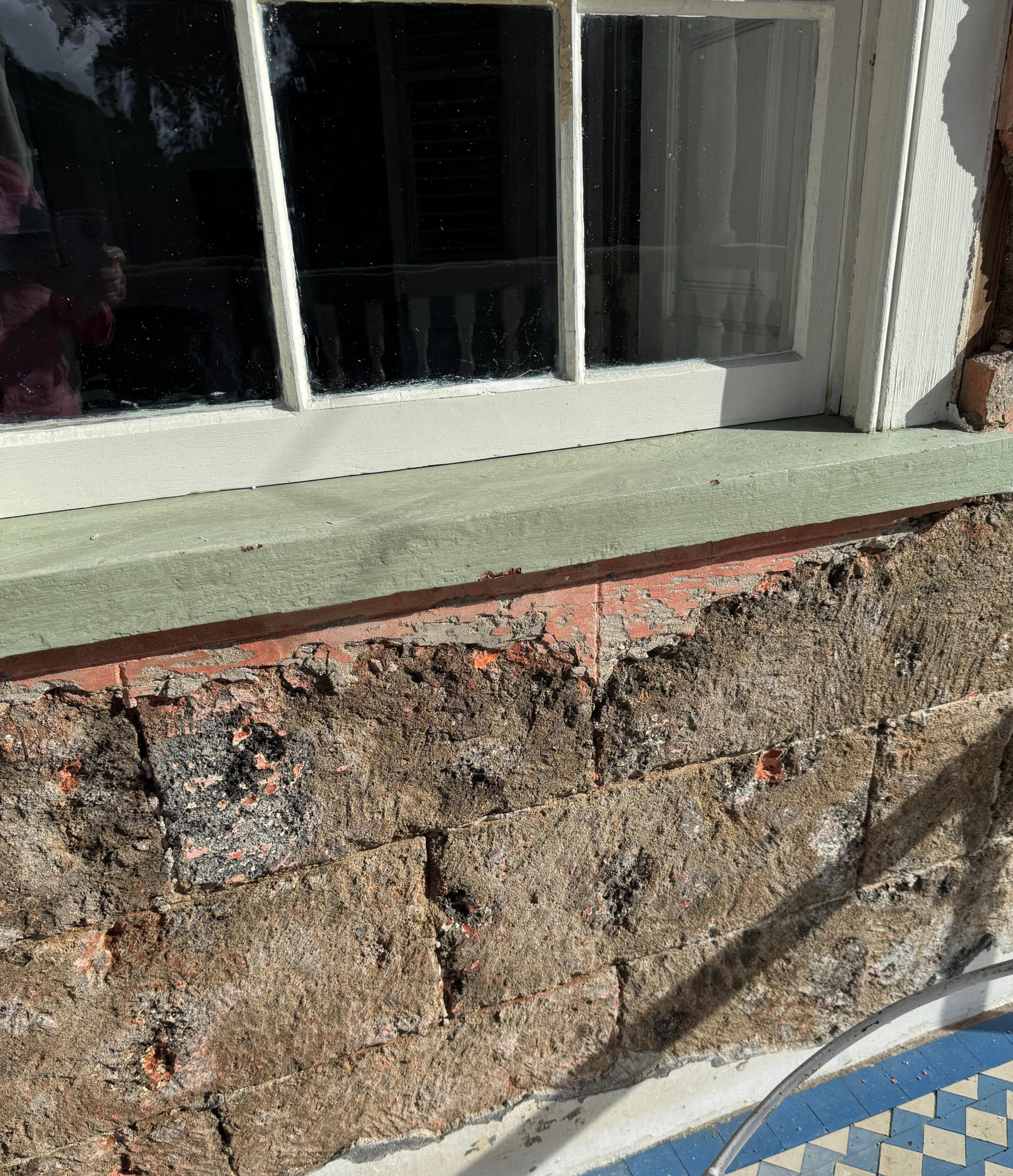
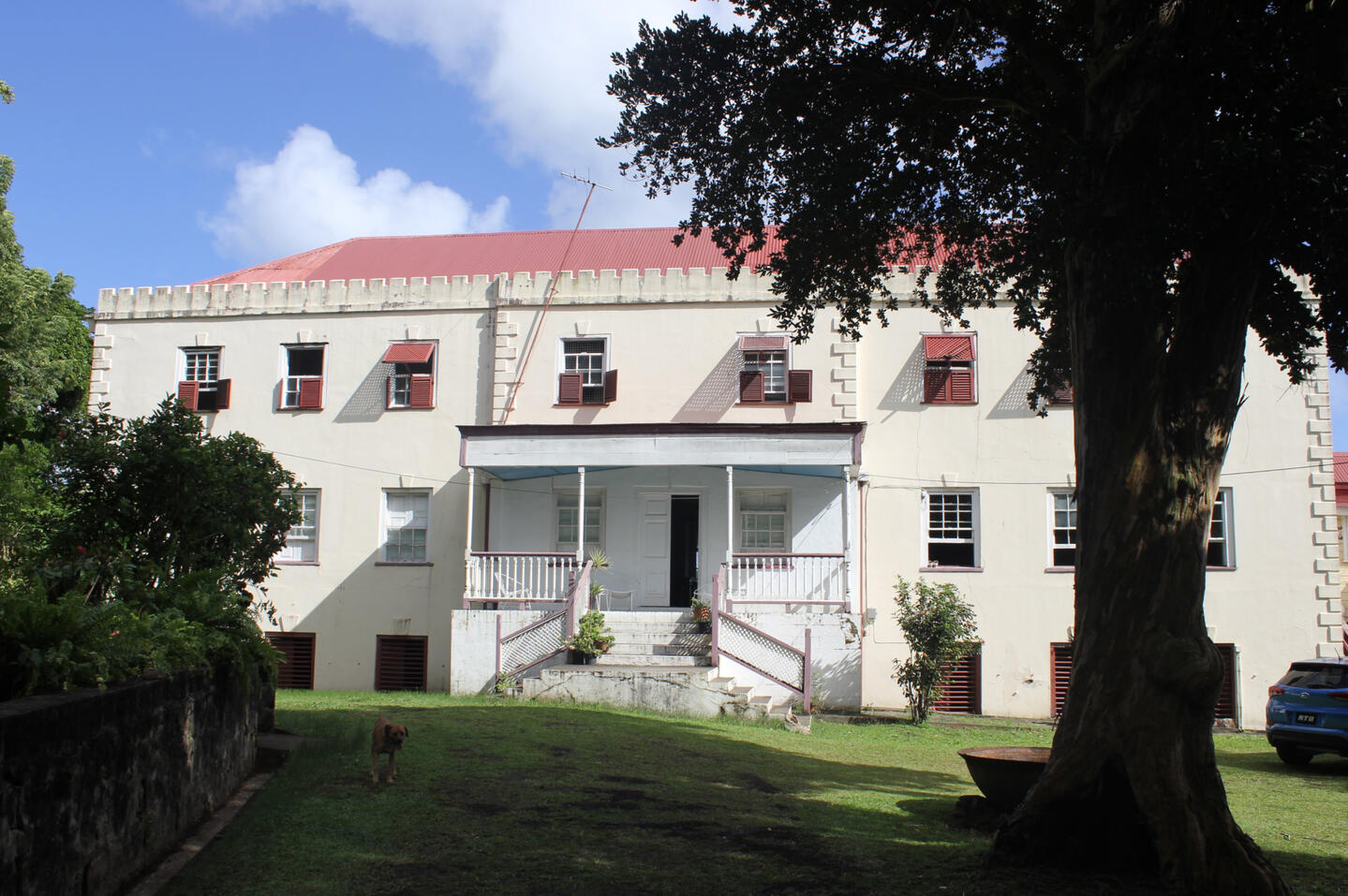
Arnos Vale House is a substantial late-eighteenth-century stone house, with massive walls estimated to be between 800mm and 1,000mm thick. It was most likely built between about 1763 and 1785 by the Greathead family. The early owners of the house and the surrounding 454-acre Arnos Vale Estate were Samuel Greathead — also sometimes recorded as Greatheed — whose family came originally from England via St Christopher, now St Kitts, and his maternal relative, William Crooke.Architecturally, the house is built in a classical Georgian style with clear Palladian influence. It is arranged as a central block flanked by two subordinate wings. The central section, with two levels of three evenly spaced 6-over-6 sash windows, appears originally to have had a pedimented roofline, as shown in the photograph below from around 1880. The flanking wings are also pleasingly symmetrical, with sash windows aligned both vertically and horizontally.At a later date, the central pediment disappeared and was replaced by castellations. One possible explanation is that this alteration was intended to help break up or dissipate hurricane-force winds. The present roofline no longer shows the mansard roof windows visible in the 1880 photograph, suggesting that the upper part of the house had been altered, perhaps as a result of damage during the catastrophic hurricane of 1898.The house’s classical Georgian sash windows, still operating with their original heavy lead sash weights, have given rise to its local nickname: “the house with the 100 windows”. In reality, excluding the cellar windows, there are “only” 38 sash windows to maintain. Each has its own internal wooden shutters, sash cords, lead weights and old crown glass panes.The cellar, or lower ground floor, contains a further 18 windows. These are simpler in construction, with wooden shutters and internal metal bars. This lower level would historically have been used for storage, most likely for sugar hogsheads or other estate produce awaiting export.Together, the windows are one of the defining features of Arnos Vale House. They give the building much of its rhythm, elegance and character, but they also represent a significant ongoing conservation responsibility.
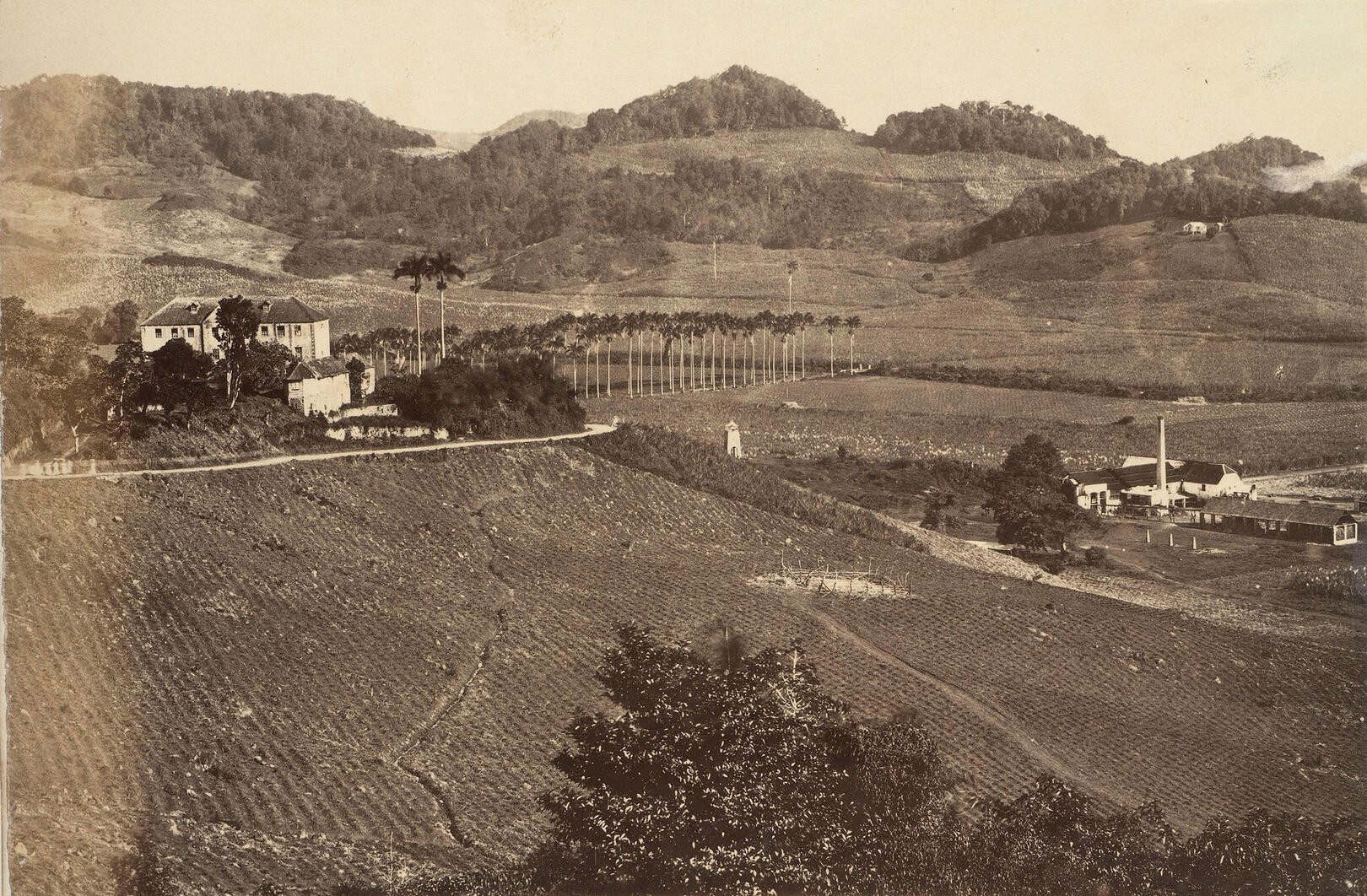
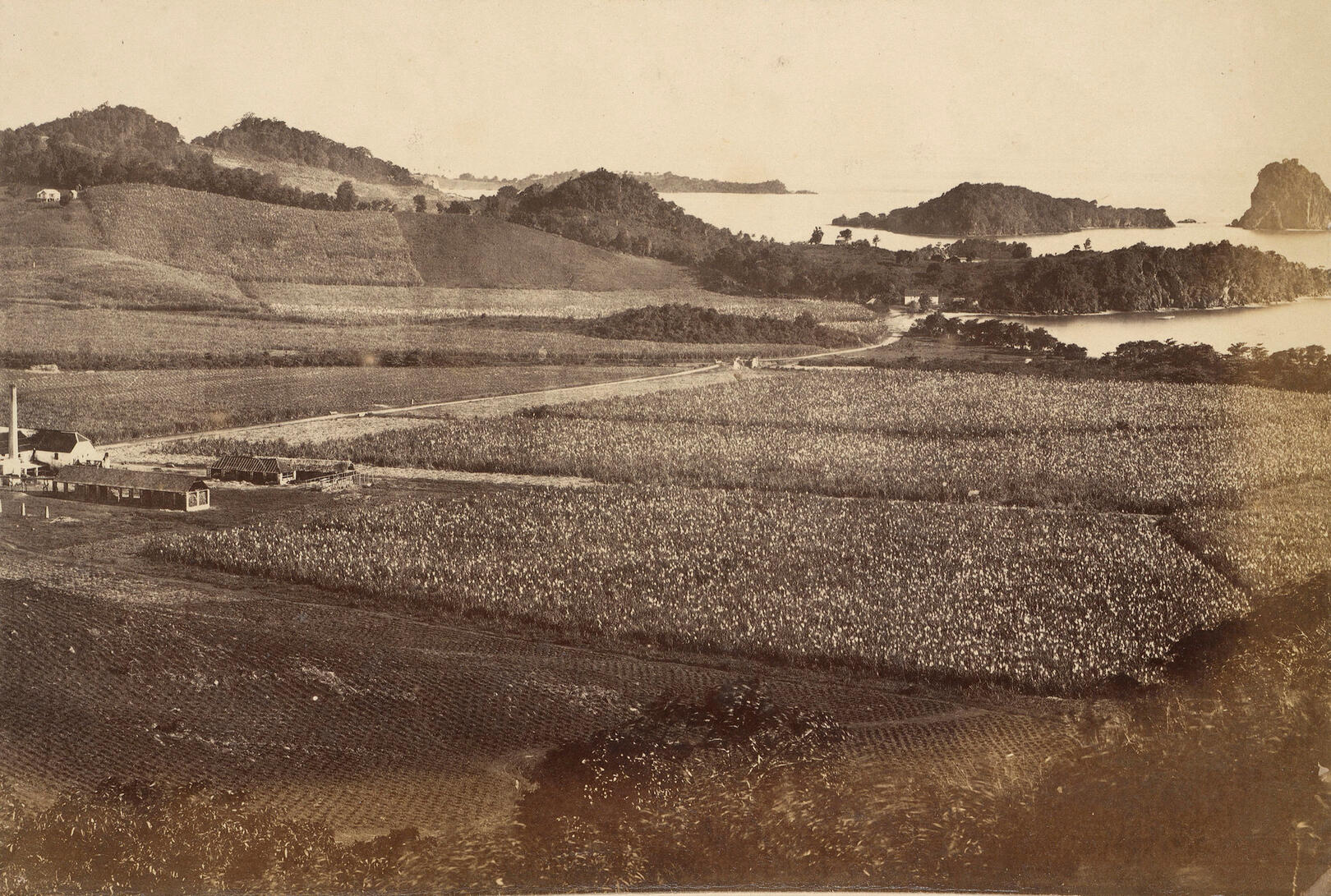
These are photographs taken in 1880 during Prince Albert Victor (1864-92) and Prince George of Wales' (1865-1936) world tour aboard HMS Bacchante from 1879 to 1882, held by the Royal Collection Trust, which shows the house in its original estate context. Below and around it are cultivated fields of sugar cane, a formal avenue of royal palms following the current road to the bridge across what later became the runway for the Arnos Vale Airport (later ET Joshua Airport) and the estate works or sugar factory (still standing) to the right, identifiable by the boiling house chimney.
Both photographs © Royal Collection Enterprises Limited 2026 | Royal Collection Trust and have been reproduced here with written permission.
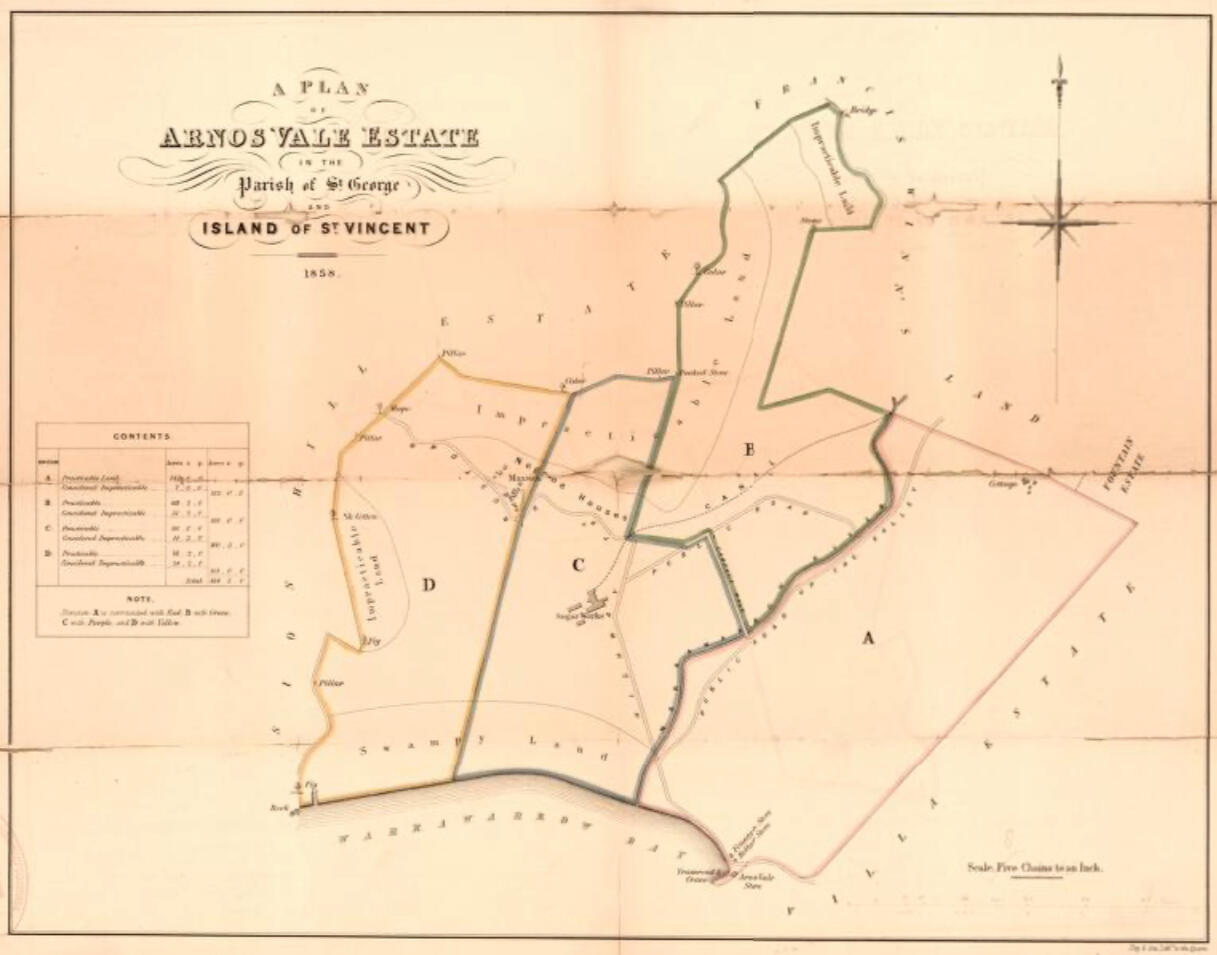
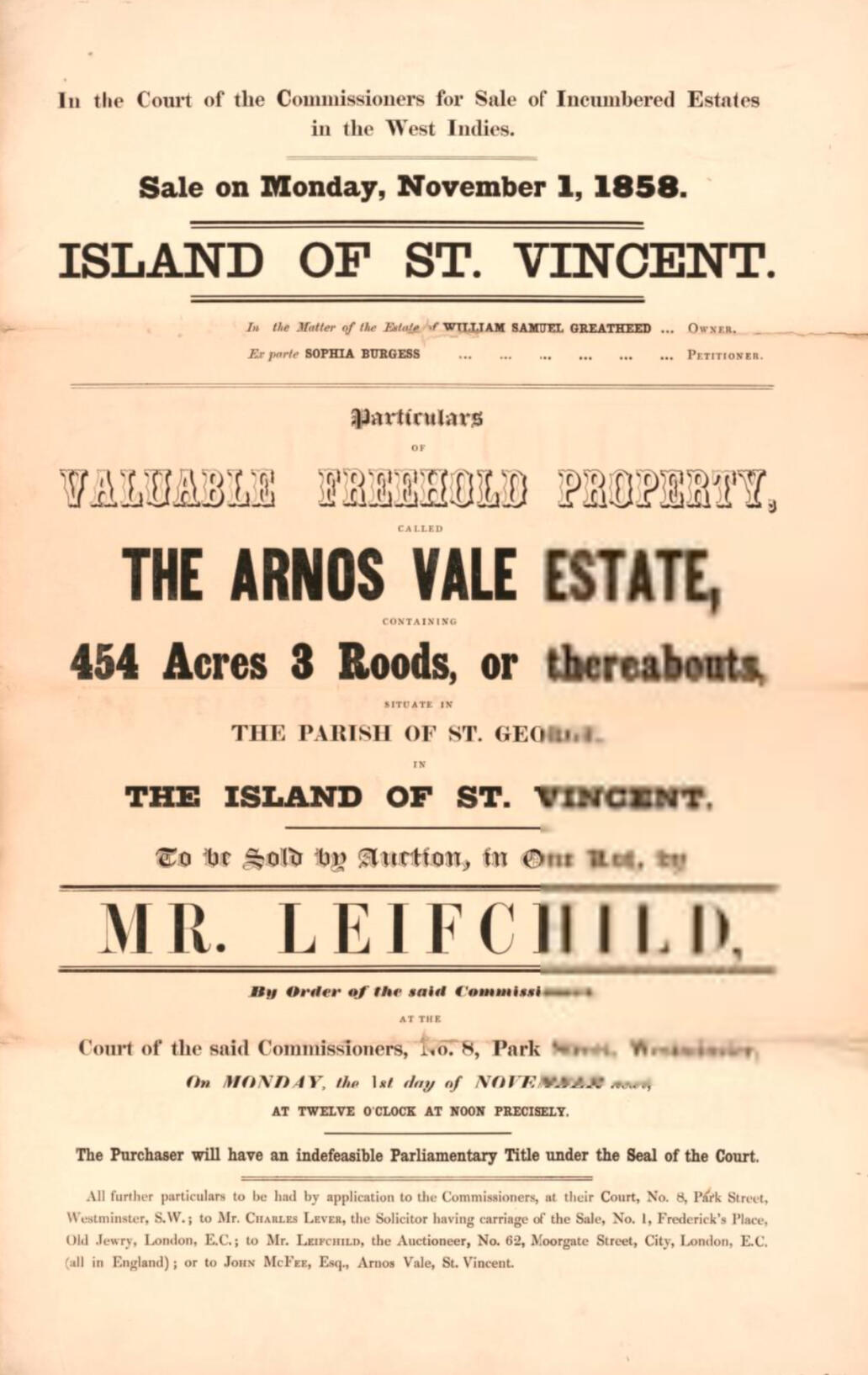
The AuctionArnos Vale remained in the Greathead family's possession until 1858. By that time, the estate was burdened with debts of more than £30,000 and became the first plantation in St Vincent to be sold through the Incumbered Estates Court in London, with an indefeasible Parliamentary title. It was sold for £10,800 — more than twice the value achieved by any other subsequent Vincentian plantation sale through the same process.The purchaser was the Rev. Francis Robert Braithwaite, a former controversial Archdeacon of St Kitts, who bought Arnos Vale Estate at auction in London on Monday, 1st November 1858.Arnos Vale later passed to Braithwaite’s son, the Rev. Francis Gretton Coleridge Braithwaite, who sold the estate in 1893 to George Richard Corea, who died at Sans Souci in 1924. George Richard Corea was the grandfather and great-grandfather of the present family owners.The photos below show the flyer for the Auction, as well as the map of the Estate in1858. The house is clearly marked, as is the canal which fed the sugar factory, and the line of royal palms which marked the road to the bridge leading to Villa and the windward highway.
Text
The CoreasThe Correia, or Correa, family arrived in St Vincent from Faial in north-eastern Madeira, Portugal, sometime from 1845 onwards. They came as part of the wider movement of Portuguese migrants to the Caribbean as indentured labourers, and may have been indentured to the British planter James Porter to work on his Windward estates.Joaquim Correia, born in 1819, is believed to have been the first member of the family to settle in St Vincent. He later lived in Kingstown and died at Arnos Vale House in 1902. Joaquim appears first in the records as a rum shop owner, being granted a licence in 1850 for the substantial sum of £50. By 1866, he had established a store in Kingstown. That same year, the Great Fire of Kingstown began upstairs in rooms occupied by his tenant, an Englishwoman music teacher, where a coal pot had been left burning. Joaquim’s store, along with many others, was destroyed, causing considerable financial loss. The fire was reported in newspapers across the world, including as far away as New Zealand.Joaquim had at least two sons, Joseph and George. Joseph remained in Kingstown, while George Richard Corea, born in Georgetown, went into partnership with another Portuguese settler, Manuel dos Santos. Together they acquired Sans Souci, Mount Grennan and Gorse plantations on the Windward side of the island.In 1893, George Richard Corea purchased Arnos Vale Estate from the Rev. Francis Gretton Coleridge Braithwaite. George died in 1924 and is buried in the Roman Catholic section of Kingstown Cemetery. In 1918, he transferred Arnos Vale Estate to his younger son, Frederick Augustine Corea.A family story recalls that George Richard Corea used to tether his horse to a nail in one of the old West Indian bay leaf trees, 'Pimenta racemosa', in the yard at Arnos Vale House. If so, these magnificent trees must be at least 120 years old, and possibly older. They have witnessed hurricanes, changing generations and the daily life of the estate. They have also provided shelter for flocks of blackbirds, now sadly gone following agricultural spraying in the 1960s and 1970s, as well as honey bees, iguanas and the local owls that still form part of the landscape of Arnos Vale.